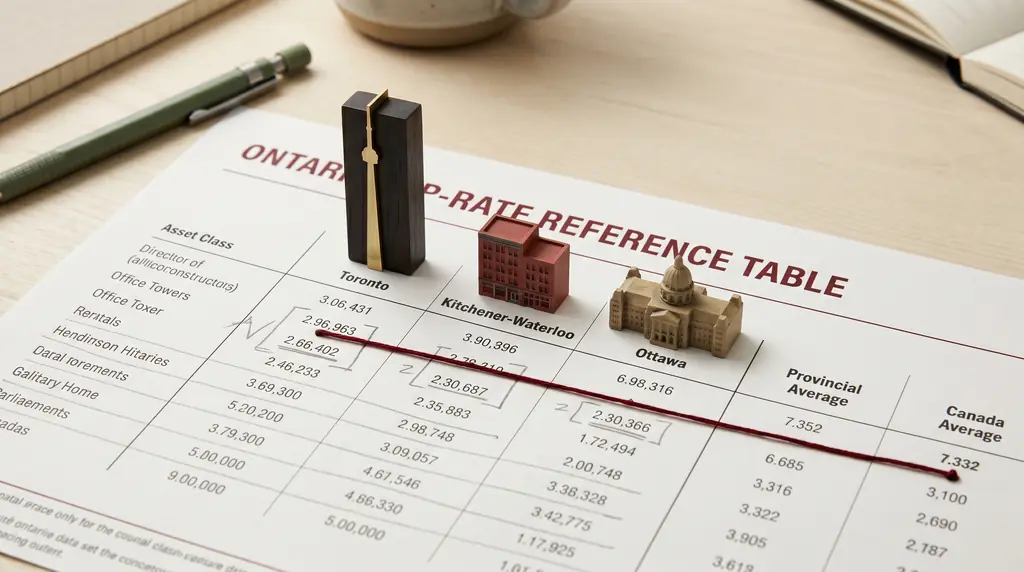
GTA office cap rates are compressing. The Altus Group Q4 2025 Canadian CRE Investment Trends Survey (January 20, 2026) records Downtown Class AA office at 6.59% nationally, a 25 bps QoQ compression. CBRE's parallel Downtown Class AA and A series posted its largest quarterly compression in over 13 years, down 10 bps to a 7.48% national average (CBRE Q4 2025). The move is concentrated in Trophy and AA assets: Toronto Class AAA vacancy was below 2% at year-end 2025 even as overall Toronto office availability remains elevated at 15.5% in Q1 2026, down 270 bps YoY (Altus Q1 2026 office update, April 22, 2026). The macro frame is a Bank of Canada overnight rate held at 2.25% through six consecutive decisions, most recently on July 15, 2026. This post sets out the headline numbers, what is driving them, and how AACI commercial appraisers are reading the GTA comp set.
Key Takeaways
- Altus Q4 2025: Downtown Class AA office at 6.59% nationally, down 25 bps QoQ. In CBRE's parallel series, Downtown Class AA and A cap rates posted their largest one-quarter compression in over 13 years, down 10 bps to 7.48%.
- CBRE Q4 2025: national Downtown Class AA average 6.88%; Toronto-specific range 5.25-7.75%. The 250 bps span reflects the intra-AA split between standard AA and Trophy / AAA.
- Toronto office availability was 15.5% in Q1 2026 per Altus, down 270 bps YoY, with six consecutive quarters of positive net absorption downtown.
- Bank of Canada held the overnight rate at 2.25% on July 15, 2026 - the sixth consecutive hold - anchoring the 317 bps Q1 2026 spread between cap rates and the 10-year GoC.
The headline: Altus Q4 2025 GTA office cap rates
Downtown Class AA office compressed 25 bps QoQ to 6.59% per Altus Q4 2025 ITS. CBRE's Q4 2025 report separately recorded the largest quarterly compression in its Downtown Class AA and A series in over 13 years, with that national average down 10 bps to 7.48%. The Altus print sits inside an Altus four-asset benchmark OCR of 5.92% (flat QoQ), so the office print is a named asset-class re-rating, not composite noise.
| Series | Q4 2025 cap rate | QoQ change | Source |
|---|---|---|---|
| Altus Downtown Class AA office (national) | 6.59% | -25 bps | Altus Q4 2025 ITS (Jan 20, 2026) |
| CBRE Downtown Class AA office (national avg) | 6.88% | n/a in CBRE breakdown | CBRE Q4 2025 Cap Rate Report PDF |
| Altus four-asset benchmark OCR | 5.92% | flat | Altus Q4 2025 ITS |
| CBRE national all-properties average | 6.63% | -3 bps | CBRE Q4 2025 Cap Rate Report PDF |
| CBRE national all-properties average (Q1 2026) | 6.61% | -2 bps | CBRE Q1 2026 (Apr 21, 2026) |
Definitional note: Altus's Downtown Class AA series tracks downtown-core Trophy and AA product; CBRE's national Class AA average covers a broader definition across major Canadian markets. The two figures describe overlapping but not identical universes.
CBRE Q1 2026 GTA breakdown - Downtown AA, Downtown A, Suburban A, Suburban B
The CBRE Q4 2025 Canadian Cap Rate Report is the most granular public source for Toronto by asset class. CBRE Q1 2026 (April 21, 2026) moves the national headline down 2 bps to 6.61% without changing the structural picture.
| Toronto office segment | CBRE Q4 2025 range |
|---|---|
| Downtown Class AA | 5.25 - 7.75% |
| Downtown Class A | 6.25 - 7.00% per CBRE Q4 2025 |
| Downtown Class B | 6.75 - 7.50% per CBRE Q4 2025 |
| Suburban Class A | 7.25 - 8.25% per CBRE Q4 2025 |
| Suburban Class B | 8.00 - 9.00% per CBRE Q4 2025 |
The 5.25-7.75% Downtown Class AA range is diagnostic. A 250 bps span inside one class signals the intra-AA split: Trophy / AAA at the tight end, standard Class AA at the wide end. Altus refers to a separate Class AAA / Trophy tier above Class AA; CBRE's national series still tops out at Class AA, so AAA surfaces inside the range, not as a separate row.
What is driving compression - the BoC hold and Toronto availability down 270 bps year-over-year
The cost-of-debt environment. The Bank of Canada held the overnight rate at 2.25% on July 15, 2026 - the sixth consecutive hold, after a cumulative 100 bps of 2025 cuts (CBRE Q4 2025). The 10-year GoC was effectively flat QoQ in Q1 2026; the spread between the all-properties cap rate and the 10-year GoC tightened to 317 bps. A tighter spread on stable rates is the textbook signature of investors compressing risk premia on quality assets.
The demand pattern inside the office stack. Toronto office availability was 15.5% in Q1 2026, down 270 bps YoY, with six consecutive quarters of positive net absorption downtown (Altus Q1 2026); Toronto Class AAA vacancy was below 2% at year-end 2025 per Altus; CBRE's Q2 2026 office figures put it at 2.6%, still the tightest premium segment in Canada. Headline availability that high coexisting with Trophy vacancy below 3% defines a bifurcated market - and the cap rate response is bifurcated to match. Trophy compresses; standard Class A holds; Class B and suburban remain wide. Supply reinforces the scarcity: the national office construction pipeline is 2.8M sf across 17 buildings in Q1 2026 (Altus), a multi-year low.
What it means for valuations - the arithmetic of the income approach
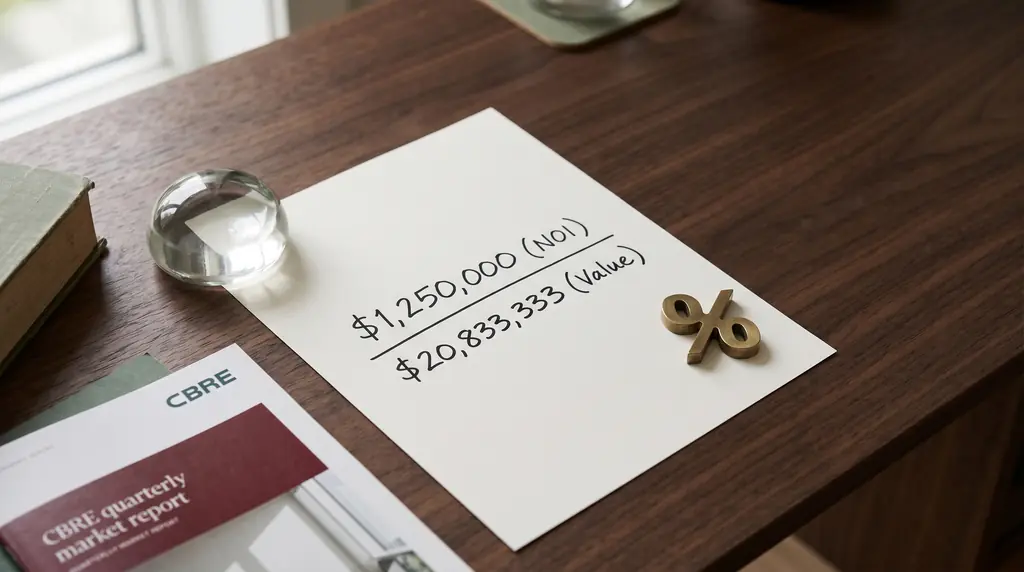
Compression mechanically raises value under the income approach (what is a cap rate: Value = NOI / Cap rate). On a Trophy asset generating $10M of stabilized NOI, a move from 5.50% to 5.25% raises implied value from $181.8M to $190.5M - roughly 4.8% on a 25 bps move, NOI held constant. Full mechanics: how cap rates affect commercial valuation.
For refinance underwriting, the compression is real but narrow. It applies to the top of the office stack and does not extend into Class A standard, Class B, or suburban - and the bid-ask gap Altus flagged in Q4 2025 (2025 total Canadian CRE volume ~$51 billion, -8% YoY) continues to suppress transaction velocity. For an asset acquired in 2021 at sub-5% pricing rolling 2021 debt at 2026 spreads, AA-tier compression does not change the arithmetic unless the asset is itself Trophy / AAA - the lender-underwriting view is in our Canadian CRE refinance cycle analysis. For acquisitions, the implication reverses: buyers underwriting Trophy GTA office in Q2 2026 are pricing to a tighter going-in than in Q3 2025, compressing unlevered yield and lengthening hold periods to clear hurdle returns.
How AACI commercial appraisers are reading the comp set in Q2 2026
Three reading rules carry the weight in practitioner work right now, and we are conservative about each.
- Disclose which series. Altus 6.59% and CBRE 6.88% Downtown Class AA Q4 2025 are both correct - they describe overlapping but not identical universes. A CUSPAP 2026-compliant appraisal citing a downtown Toronto cap rate should name the source, the quarter, the asset-class definition, and where the subject sits inside the range.
- Do not assume the compression has propagated. The Altus Q4 2025 move is a Class AA print. CBRE Class A and B figures and Altus's wider commentary do not show the same magnitude of compression in lower office tiers. The bifurcation is now intra-Class A as well - standard Class A versus AAA / Trophy is the dominant gap.
- Anchor the terminal cap rate to a defensible 2031 view. Colliers Q1 2026 flagged the possibility of rate increases later in 2026 if inflation reasserts. A terminal cap rate that implicitly embeds a 2.25% overnight rate for the entire hold is making an unstated rate-path assumption. CUSPAP 2026 asks the appraiser to defend both the going-in and the terminal independently.
For the industrial-side reading, see Ontario industrial cap rate trends.
Frequently asked questions
By how much did GTA office cap rates compress in Q4 2025?
Altus Q4 2025 ITS records Downtown Class AA office at 6.59% nationally, a 25 bps QoQ compression. CBRE Q4 2025's national Downtown Class AA average was 6.88%, and CBRE separately recorded the largest quarterly compression in its Downtown Class AA and A series in over 13 years (down 10 bps to 7.48%); the two figures describe overlapping but not identical universes.
Why are GTA office cap rates compressing in 2026?
Flight-to-quality, supported by a stable Bank of Canada policy rate. Toronto Class AAA vacancy was below 2% at year-end 2025 per Altus (2.6% in Q2 2026 per CBRE) even as overall Toronto office availability was 15.5% in Q1 2026 (down 270 bps YoY). Six consecutive quarters of positive net absorption downtown concentrated demand at the top of the office stack.
Does the compression extend to Class B and suburban office?
No. The Altus Q4 2025 25 bps move is specific to Downtown Class AA. Class A, Class B, and suburban have not shown the same magnitude in either the CBRE Q4 2025 or Altus Q1 2026 series. The market is bifurcating, not uniformly compressing.
How does Toronto Downtown Class AA at 5.25-7.75% reconcile with the 6.59% national AA average?
5.25-7.75% is CBRE's Q4 2025 Toronto-specific Downtown Class AA range; 6.59% is the Altus Q4 2025 national Downtown Class AA series average. The wide Toronto range reflects the intra-AA split between Trophy / AAA at the tight end and standard Class AA at the wide end.
Further reading
- Ontario commercial cap rates 2026 - the cluster pillar; the full Ontario picture by asset class and geography.
- what is a cap rate - the NOI / Value definition and going-in vs terminal distinction.
- how cap rates affect commercial valuation - the arithmetic of the income approach and DCF reversion.
- Canadian CRE refinance cycle - the 2021 five-year wall and how AA compression interacts with lender underwriting.
- Ontario industrial cap rate trends - the cross-Ontario industrial picture.
Commission a GTA office appraisal. If you need a CUSPAP 2026-compliant commercial appraisal grounded in the Q4 2025 / Q1 2026 evidence above and signed by an AACI-designated practitioner, request an appraisal. We serve Ontario from our Kitchener-Waterloo practice, founded in 1973.
Update log: 2026-05-14 - Initial publication. Figures verified against Altus Q4 2025 ITS (Jan 20, 2026), CBRE Q4 2025 Cap Rate Report PDF, CBRE Q1 2026 (Apr 21, 2026), Altus Q1 2026 office update (Apr 22, 2026), and the Bank of Canada Apr 29, 2026 rate decision. 2026-05-21 - Toronto Downtown Class A/B and Suburban Class A/B cap rate rows populated from CBRE Q4 2025 Canadian Cap Rate Report PDF. 2026-07-15 - Fact-check pass: the 13-year compression superlative reattributed to CBRE's Downtown Class AA and A series (down 10 bps to 7.48%); Toronto Class AAA vacancy dated to year-end 2025 and refreshed with CBRE Q2 2026 (2.6%); Bank of Canada hold count updated to sixth consecutive (July 15, 2026); dead CBRE PDF links replaced with the live CBRE cap rate report page.