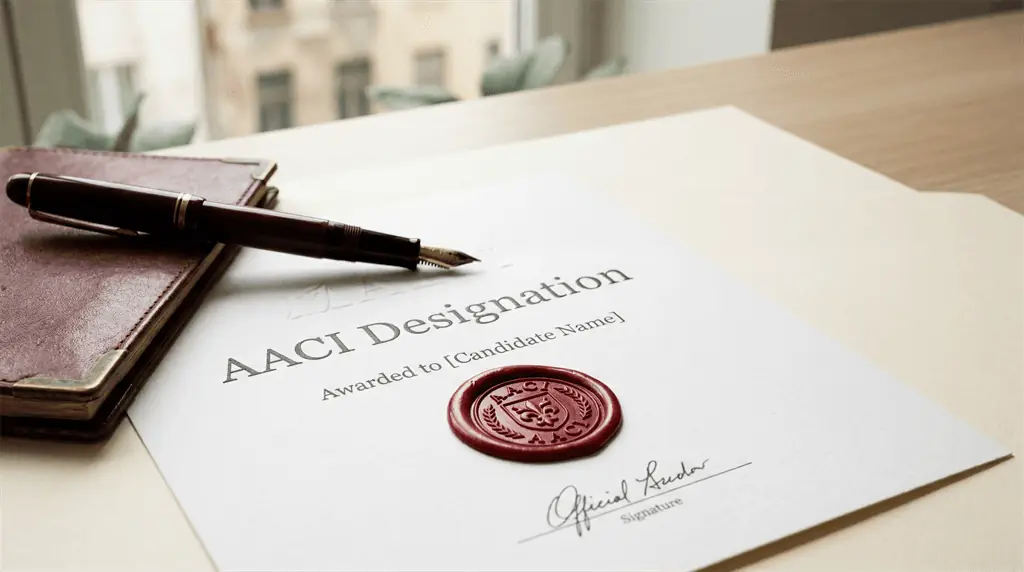
An AACI Candidate Member is an Appraisal Institute of Canada (AIC) member enrolled in the supervised pathway toward the Accredited Appraiser Canadian Institute designation - completing UBC coursework, applied experience under a co-signing Designated Member, peer-reviewed demonstration work products, the Professional Practice Seminar, and the Applied Experience Exam (a university degree is required before sitting it), all within a 10-year cap from the date of joining (AIC, 2026).
Key Takeaways
- AACI Candidate Member is a defined AIC membership tier - carrying PLI obligations, a co-signature requirement on every report, and a fixed 10-year limit to reach designation.
- The standard pathway requires 15 UBC Sauder courses (13 BUSI courses, introductory financial accounting, and a guided case study), a university degree, two years of applied experience, and the Applied Experience Exam; typical completion is two to six years (AIC, 2026).
- The accelerated PGCV pathway compresses coursework to six courses for Candidates who already hold a Canadian business or commerce degree; UBC states the coursework can be finished in as little as two to three terms, leaving the two-year applied-experience floor as the binding minimum (AIC, 2026; UBC Sauder).
- AACI is the commercial-scope designation; CRA is residential-only. Candidate status is the path to either, but the BUSI mix, co-signer's designation, and demonstration work products must align with the target track.
What "AACI Candidate Member" status means
Candidate Member is a working membership tier inside the AIC. A Candidate is not yet designated - the practitioner cannot independently sign an appraisal report - but is formally enrolled and counted in the AIC's 5,000+ member figure (AIC, 2026). The 10-year clock starts the moment the AIC approves the application.
Three obligations attach immediately. PLI must be in force within 30 days of approval at the Candidate-Fee premium published in the AIC FAQ. Annual dues run $875 to $1,500. And every report a Candidate works on must be co-signed by an AIC Designated Member in the Candidate Co-signing Registry. The path is an apprenticeship: coursework supplies the academic floor, the co-signer supplies judgement, and peer review under CUSPAP calibrates the work against the standard.
Standard pathway requirements
The standard route runs through the UBC Sauder Real Estate Division and the AIC's Applied Experience Program in parallel.
Coursework - 15 courses. The AACI list runs 13 BUSI courses from BUSI 100 through BUSI 460, plus introductory financial accounting and a guided case study (BUSI 497 or 499), covering real estate finance, valuation theory, statistical foundations, commercial valuation, income-property analysis, and capstone work. BUSI 400 or BUSI 401 must be completed within the first 12 months of candidacy (AIC, 2026).
Applied experience - two years minimum, then the exam. Candidates accumulate documented hours of supervised commercial valuation work under their co-signer, recorded through the AIC's Applied Experience Program. Two years is the floor before a Candidate can write the AACI Applied Experience Exam, and a university degree must be completed before sitting that exam (AIC, 2026).
Demonstration appraisal reports - the Work Product Review. Every Candidate who joined after January 2014 must submit a series of increasingly complex CUSPAP-compliant work products, vetted by trained peer reviewers. The final submission must comply with CUSPAP or be resubmitted within 30 days (AIC, 2026). For the commercial track these are commercial-scope reports - typically an income-property file, a comparable-sales file, and a multi-approach or special-purpose file. WPR feedback is shared with the co-signer.
Professional Practice Seminar. The PPS is required for Candidate acceptance and must be completed to maintain Candidate membership through to designation.
The AIC publishes the standard completion range as two to six years, with the 10-year cap as the outer limit (AIC, 2026). In our observation, most commercial Candidates land in the four-to-six-year window once AEP hours, WPR submissions, and the BUSI sequence are paced alongside billable work.
Accelerated pathway (PGCV, 6 courses)
For Candidates who already hold a Canadian business or commerce degree, the AIC recognises an accelerated path via the UBC Post-Graduate Certificate in Real Property Valuation (PGCV). The PGCV substitutes for the standard 15-course sequence: six courses - five core (BUSI 331, 401, 442, 452, and 497 or 499) plus one elective from BUSI 300, 344, 443, or 460 (AIC, 2026).
UBC states the PGCV coursework can be completed in as little as two to three terms; on the accelerated path the binding time floor is the AIC's two-year applied-experience requirement, not the coursework (UBC Sauder; AIC, 2026). Applied experience, WPR submissions, PPS, the Applied Experience Exam, and the 10-year cap all continue to apply. The accelerated path compresses the academic component, not the practice-and-peer-review component.
AACI vs CRA - choosing the commercial path
The AIC confers two designations and Candidate status is the path to either. The choice must be made early, because the BUSI mix, WPR files, and co-signer's designation must align with the target.
AACI is the commercial-scope designation, qualifying the holder to sign appraisals of all types of real property under CUSPAP: office, retail, industrial, hospitality, multi-residential, special-purpose, agricultural, and land (AIC, 2026). Machinery and equipment assignments fall under CUSPAP's separate machinery and equipment standard, subject to the Member's competency. See what is the AACI designation for fuller treatment. CRA - Canadian Residential Appraiser - is residential-only and cannot sign commercial, industrial, or agricultural reports. The CRA program is shorter (two to three years average) but a parallel track, not a stepping stone. For Candidates aiming at independent commercial appraisal practice in Ontario, the AACI track is the only route.
The co-signature rule during candidacy
The load-bearing constraint of Candidate status is the co-signature requirement. Every report a Candidate works on must be co-signed by an AIC Designated Member in the Candidate Co-signing Registry. The co-signer is the named, accountable practitioner under CUSPAP - the Candidate contributes work, but the co-signer's name appears on the report and carries the AIC peer-review and PLI exposure.
The co-signer reviews the analysis, confirms the methodology meets CUSPAP, and answers to the AIC if the file is reviewed or litigated. The relationship is structured mentorship - a Candidate cannot find a co-signer-of-convenience and operate independently. For independent firms, the rule shapes workflow design, a recurring theme in recruiting the next generation of AACI appraisers and in succession planning.
Cost and timeline
The cost stack during candidacy has four lines:
- AIC Candidate dues: $875 to $1,500 per year; first-year Candidates pay discounted dues of $300 to $600 (AIC, 2026).
- AIC PLI Candidate premium (fee category): $2,444 to $2,739 per year for the 2025 cycle, with $2 million aggregate coverage per year; a separate non-fee category exists, and the current cycle's rates should be confirmed with AIC (AIC, 2026).
- UBC BUSI tuition: Most BUSI courses are $745 early / $795 regular per course; BUSI 344, 444, and 460 are $795 early / $845 regular; capstone courses BUSI 497 and 499 are $1,645 early / $1,695 regular per UBC Sauder Real Estate Division 2026 (fees effective January 1, 2026). The 15-course standard sequence and the 6-course PGCV are billed per course directly to the Candidate.
- PPS and WPR fees: The Professional Practice Seminar registration fee was $345 + tax for the AIC Ontario 2024–25 PPS cycle, which closed December 31, 2024; confirm the current cycle's fee with AIC Ontario. The per-submission WPR fee is not published on the AIC public site; contact AIC Membership Services for the current rate.
On timeline: two to six years for the standard path, a shorter runway on the PGCV accelerated path (coursework in as little as two to three terms, bounded by the two-year applied-experience floor), and a hard 10-year cap from Candidate approval to designation (AIC, 2026; UBC Sauder). The cap is the operating constraint - Candidates who run long can lose the right to designate without a reset.
Frequently asked questions
How long does AACI candidacy take?
The AIC publishes an average of two to six years for the standard path, with a 10-year hard cap from Candidate approval to designation (AIC, 2026). The PGCV accelerated path compresses the coursework (UBC states as little as two to three terms), leaving the two-year applied-experience floor as the binding minimum. In our observation, most commercial Candidates running the standard path alongside billable work land in the four-to-six-year window.
Can I work as an appraiser before designation?
Yes, but not independently. As a Candidate Member you can work on commercial files, accumulate AEP hours, and contribute analysis to reports. Every report must be co-signed by an AIC Designated Member in the Candidate Co-signing Registry; the co-signer's name carries the CUSPAP accountability. You cannot sign a commercial appraisal independently until AACI is conferred.
What happens if I exceed the 10-year cap?
The 10-year limit from Candidate approval to designation is a hard cap (AIC, 2026). Candidates who do not complete designation within that window lose Candidate status. The AIC sets the conditions for any reinstatement, administered by Membership Services and Professional Practice; the specific reinstatement conditions are not published on the AIC public site - contact AIC Membership Services directly for the current policy.
Further reading
- Independent commercial appraisal practice economics - the pillar on running a CUSPAP-disciplined independent firm in Canada, including the Candidate-mentorship line in the cost stack.
- What is the AACI designation - companion glossary on the senior AIC designation Candidates are working toward.
- Recruiting the next generation of AACI appraisers - how an independent practice attracts and supervises Candidates.
- Succession planning for a commercial appraisal firm - why Candidate Member mentorship is the leading indicator of a viable succession plan.
- Peer review under CUSPAP - what gets reviewed, by whom, and how the Work Product Review feeds back into the path to designation.
To commission a commercial appraisal from a Kitchener-Waterloo AACI practice since 1973 - Appraisals.on.ca - request an appraisal and our team will respond within one business day.
Update log: 2026-05-16 - Initial publication. 2026-05-21 - UBC BUSI tuition rates and PPS registration fee inserted from public AIC and UBC Sauder sources; WPR per-submission fee and 10-year reinstatement policy noted as not publicly available. 2026-07-15 - Course count corrected to 15 (13 BUSI plus accounting plus case study); Applied Experience Exam and degree prerequisite added; PGCV timeline corrected per UBC Sauder; PPS fee dated to the closed 2024–25 cycle; PLI coverage restated as aggregate.