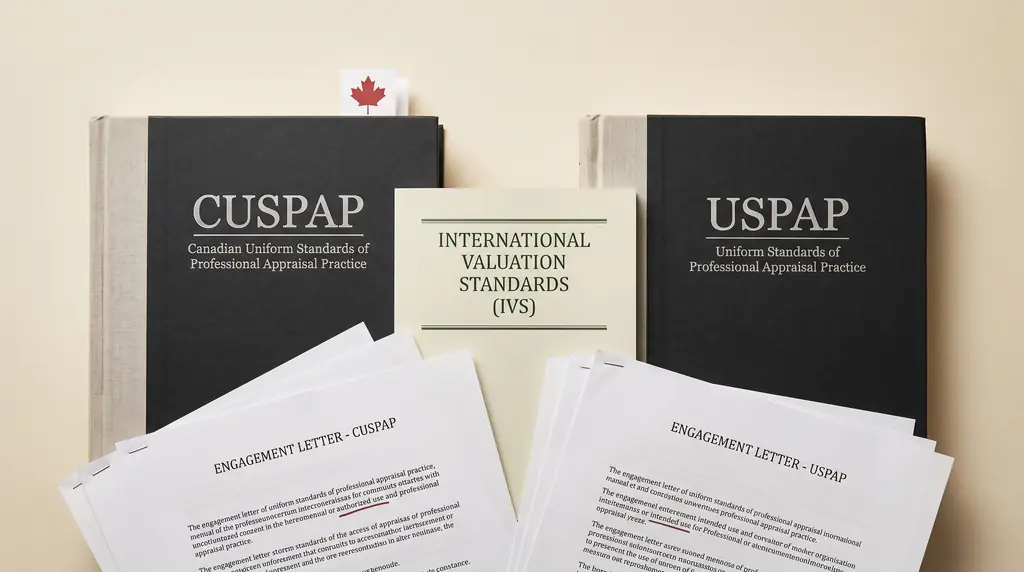
CUSPAP is the Canadian standard for professional appraisal practice, issued by the Appraisal Institute of Canada (AIC) and compulsory for all professional services assignments performed by AIC members. USPAP is the US standard, authorized by Congress in 1989 and administered by The Appraisal Foundation, required for all federally-related appraisals in the United States. Both frameworks share a common origin in the joint US-Canadian appraisal-organization committee of the late 1980s, but they diverge in scope, report-format structure, and enforcement structure.
Key Takeaways
- CUSPAP governs Canadian appraisal practice; USPAP governs US appraisal practice. They are not interchangeable for regulatory purposes.
- Both standards share a common 1980s origin and require designated/licensed practitioners, structured reporting, and ethical conduct.
- They diverge in report-format structure (USPAP 2024 defines two written report options - the Appraisal Report and the Restricted Appraisal Report; CUSPAP 2026 s. 7.5.3 defines three report formats - Form, Concise, and Comprehensive), enforcement bodies, and jurisdictional applicability.
- A USPAP appraisal is generally not accepted for Canadian lender-required commercial work. CUSPAP + AACI designation is the Canadian institutional standard.
- Cross-border engagements typically specify both standards in the engagement letter and confirm the practitioner's credentials in both jurisdictions.
Where the two standards align - common 1980s origin and shared rigor.
Both CUSPAP and USPAP trace their lineage to the 1987 formation of The Appraisal Foundation - founded by seven US appraisal organizations together with the Appraisal Institute of Canada - and the subsequent authorization of USPAP by the US Congress in 1989 (Beatty, Evolution of CUSPAP, 2005). The AIC adopted USPAP as its own standard in 1994, then published the first standalone CUSPAP in 2001.
Both frameworks require:
- A designated or licensed practitioner who takes personal responsibility for the report
- Structured reporting with defined minimum content requirements
- Ethical conduct standards governing competency, objectivity, and confidentiality
- Retained workpapers supporting the conclusions in the report
- Continuing education and professional-development obligations
Practitioners credentialed under either framework operate under comparable professional-conduct expectations. The rigour is equivalent - the jurisdictional application differs.
Where they diverge - three material differences for Canadian commissioners.
1. Report formats and reporting structure
USPAP 2024 defines two written report options - the Appraisal Report and the Restricted Appraisal Report (Standards Rule 2-2) - and does not dictate the form, format, or style of the report. CUSPAP 2026 names three report formats in s. 7.5.3 - the Form Report, the Concise Report, and the Comprehensive Report - and sets out required content in a compact, unified Reporting Standard. In earlier editions the structural gap was wider: USPAP's reporting options once ran to 8-9 pages across five sections of the document, against roughly one page in CUSPAP (Beatty, Evolution of CUSPAP, 2005). Neither approach is less rigorous - the two standards simply structure reporting requirements differently.
2. Enforcement bodies
CUSPAP is enforced by the AIC through member discipline and, in some provinces, through provincial regulatory bodies that recognise AIC designations. USPAP is enforced through state-level appraiser licensing and certification boards, with The Appraisal Foundation setting the standards but not directly enforcing them. The enforcement architecture is fundamentally different: AIC is a single national body; US enforcement is distributed across 50+ state boards.
3. Jurisdictional applicability
CUSPAP applies to AIC members - the AACI and CRA designations, both carrying the P.App. mark - performing Canadian work. USPAP applies to US state-licensed and state-certified appraisers performing federally-related US work. A Canadian AACI performing work in Canada follows CUSPAP. A US MAI performing work in the US follows USPAP. Cross-border work requires explicit engagement-letter specification of which standard applies.
Can a USPAP appraisal be used for a Canadian transaction?
Generally, no - for Canadian lender-required commercial appraisals. In our experience, Canadian lenders, OSFI-regulated institutions, and Canadian courts expect CUSPAP-compliant reports signed by an AIC-designated practitioner (AACI for commercial work). A USPAP-compliant report from a US-licensed appraiser does not typically satisfy this requirement, regardless of the report's quality.
Exceptions exist for cross-border institutional reporting where the engagement letter explicitly accepts USPAP - typically in multi-jurisdictional portfolio valuations where a single methodology framework is applied across US and Canadian assets. In these cases, the Canadian assets are often also appraised under CUSPAP by an AACI practitioner, with the USPAP report serving as the US-side complement.
The practitioner's standing in Canada - specifically, their AACI or CRA designation with the AIC - is what gives the report defensibility before Canadian regulators, courts, and auditors. The standard (CUSPAP) and the credential (AACI) work together.
CUSPAP 2026 - what changed in the current Canadian standard.
CUSPAP 2026 took effect April 1, 2026, and is mandatory for all Canadian professional services assignments completed on or after that date (AIC, CUSPAP Standards). The 2026 edition maintains the framework's core structure while updating language. Among the changes: new direction on AI - a Member must not rely solely on AI-generated output and must confirm its credibility (Reporting Standard 7.5.1.viii), with expanded AI direction in AVM Output Validation (Consulting Standard 13.8) - plus new co-signing comments and data-age limits for drive-by and desktop reports (see our CUSPAP and AI explainer for how AI fits within the framework).
For commissioners (lenders, lawyers, asset managers), the practical implication is straightforward: any commercial appraisal completed on or after April 1, 2026 must be produced under CUSPAP 2026. Compliance with the current edition is the practitioner's professional obligation; engagement letters typically just confirm "CUSPAP-compliant."
Choosing the right standard for your engagement.
| Scenario | Standard | Credential |
|---|---|---|
| Canadian lender, Canadian property, Canadian regulator | CUSPAP | AACI (commercial) or CRA (residential) |
| US lender, US property, US-regulated transaction | USPAP | State-licensed or state-certified appraiser |
| Cross-border portfolio (Canadian + US assets) | Both - specify in engagement letter | AACI for Canadian assets; US credential for US assets |
| IFRS institutional reporting (Canadian REIT/pension) | CUSPAP + IVS methodology references | AACI |
| Canadian court / litigation | CUSPAP | AACI with expert-witness availability |
When in doubt: Canadian property + Canadian commissioner = CUSPAP + AACI. The engagement letter should specify the standard explicitly.
Frequently asked questions
Are CUSPAP and USPAP aligned?
They share a common origin and comparable rigour, but they are separate standards maintained by separate bodies (AIC for CUSPAP; The Appraisal Foundation for USPAP). They are not interchangeable for regulatory or lender-acceptance purposes.
Who sets USPAP standards?
The Appraisal Standards Board of The Appraisal Foundation, authorized by the US Congress in 1989 through Title XI of the Financial Institutions Reform, Recovery, and Enforcement Act (FIRREA). State boards enforce compliance.
Who sets CUSPAP standards?
The Appraisal Institute of Canada (AIC), the national professional body for appraisers in Canada. CUSPAP is updated biennially; the current edition (2026) took effect April 1, 2026.
Can a US appraiser do work in Canada?
A US-licensed appraiser without an AIC designation (AACI or CRA) cannot produce a CUSPAP-compliant report. For Canadian lender-required or court-required work, an AIC-designated practitioner is necessary. Some practitioners hold credentials in both jurisdictions.
What is USPAP used for?
USPAP is required for all federally-related real estate appraisals in the United States - primarily mortgage lending regulated by federal agencies (FDIC, OCC, NCUA, Federal Reserve). It also applies to many state-regulated appraisal assignments and is the standard of practice for US-credentialed appraisers.
Does my Canadian lender accept USPAP reports?
In our experience, Canadian lenders regulated by OSFI expect CUSPAP-compliant reports from AIC-designated appraisers. A USPAP report from a US-credentialed appraiser would not typically satisfy a Canadian lender's appraisal requirement for a Canadian property.
Related: For how AI fits within CUSPAP-compliant practice, see CUSPAP and AI in Commercial Appraisal. Ready to commission a CUSPAP-compliant commercial appraisal in Ontario? Request an appraisal. Learn more about our AACI-designated Kitchener-Waterloo practice.
Update log: 2026-05-10 - First published. 2026-07-15 - Report-format comparison updated to current editions (USPAP 2024 SR 2-2; CUSPAP 2026 s. 7.5.3); CUSPAP 2026 AI provisions noted; applicability wording tightened to AIC members.