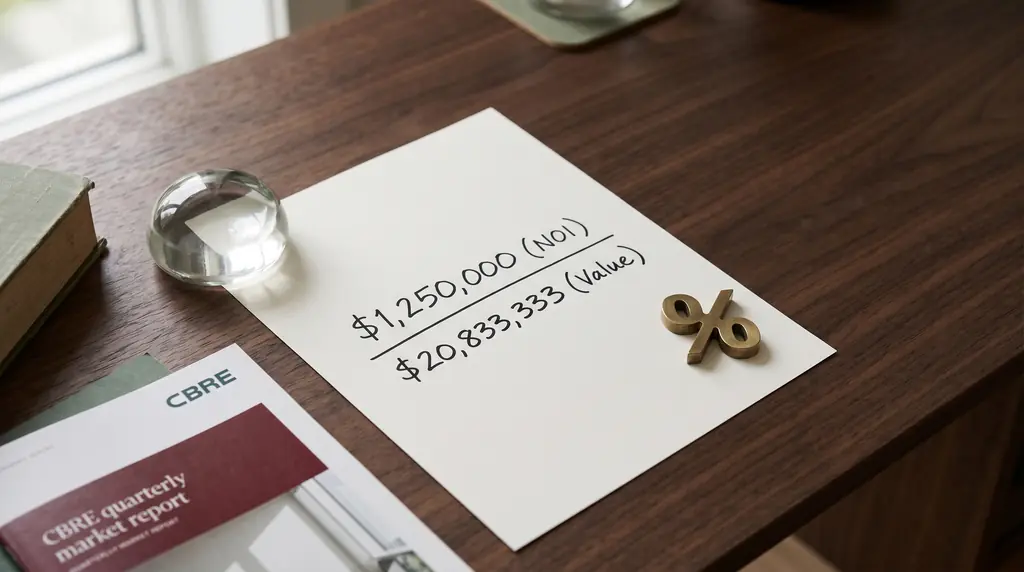
Cap rate (capitalization rate) is the ratio of a commercial property's stabilized net operating income (NOI) to its market value or transaction price, expressed as a percentage: Cap rate = NOI / Value. It is the single most-cited summary statistic in commercial real estate valuation under the income approach, and the Canadian national all-properties average sat at 6.61% in Q1 2026 per CBRE Canada.
Key takeaways
- Cap rate = NOI / Value, solved as Value = NOI / Cap rate when pricing a property from its income stream.
- A cap rate is a one-year snapshot of income against price - not a discount rate, not a forecast, and not a substitute for a full valuation.
- The going-in cap rate reflects year-one NOI at acquisition; the terminal (or reversion) cap rate is the assumed exit-year cap rate inside a discounted cash flow model.
- The Canadian national all-properties average was 6.61% in Q1 2026 per CBRE; the spread over the 10-year Government of Canada bond was 317 bps.
The formula and what each variable means
The capitalization rate is defined by a two-variable formula: Cap rate = Net Operating Income (NOI) / Value. Rearranged for valuation, the same identity reads Value = NOI / Cap rate.
NOI is gross rental income plus other property income, less vacancy and credit loss, less operating expenses (property taxes, insurance, utilities, repairs and maintenance, management, structural reserves). NOI is stated before debt service, income tax, depreciation, and capital expenditures beyond reserves, and is normally stabilized to a representative steady-state year. Value is market value as defined in the Canadian Uniform Standards of Professional Appraisal Practice (CUSPAP 2026) or the transaction price paid. The cap rate is the one-year unlevered yield at that price, ignoring growth, financing, and capital reinvestment.
What a cap rate tells you
A cap rate compresses three signals into one number. Yield: the year-one unlevered return on the purchase price - a 6.00% cap rate on a $10M property implies $600,000 of stabilized NOI before debt service. Risk: lower cap rates mean higher prices for the same income, paid for durable income, strong tenants, prime locations, and Trophy quality; higher cap rates reflect weaker tenancy, secondary location, older improvements, or lease-rollover exposure. Market sentiment: the spread between cap rates and the 10-year Government of Canada bond yield captures the risk premium over the risk-free benchmark. CBRE recorded a Q1 2026 spread of 317 bps at the national all-properties average - tighter quarter-over-quarter.
Going-in vs terminal cap rate
The most common cap rate error is treating one number as if it answers two different questions.
The going-in cap rate is the year-one stabilized NOI divided by the acquisition price. It is the figure CBRE, Altus Group, Colliers, Avison Young, and JLL report in their quarterly surveys.
The terminal cap rate (also called the reversion or exit cap rate) is the assumed cap rate applied to year-(N+1) NOI at the end of a discounted cash flow hold period, used to derive reversion value. In a typical 10-year DCF, reversion can represent 50-70% of total present value, so the terminal rate is load-bearing - a 50 bps move can shift implied current value by 6-10%. See our deeper treatment in DCF vs direct capitalization. CUSPAP 2026 work requires defending both going-in and terminal assumptions independently.
Asking vs achieved cap rates
Brokerage materials often quote an asking cap rate - the listing-side implied yield at the seller's asking price. The achieved cap rate is the yield implied by the price at which the asset actually trades. In a market with a wide bid-ask gap, the two diverge meaningfully; Altus Q4 2025 flagged the bid-ask spread as the central friction suppressing Canadian transaction velocity, with 2025 total CRE volume of approximately $51 billion - an 8% year-over-year decrease. Most quarterly publications (CBRE, Altus) blend completed transactions with active investor feedback and read closer to achieved than asking.
Where 2026 Ontario commercial cap rates sit
The 2026 anchor is the CBRE Q1 2026 Canadian all-properties national average of 6.61%, down 2 bps quarter-over-quarter from Q4 2025's 6.63% (CBRE Canada Q1 2026 Cap Rates and Investment Insights, April 21, 2026). The Altus Group four-asset benchmark OCR was 5.92% in Q4 2025, flat quarter-over-quarter (Altus Group Q4 2025 Canadian CRE Investment Trends Survey).
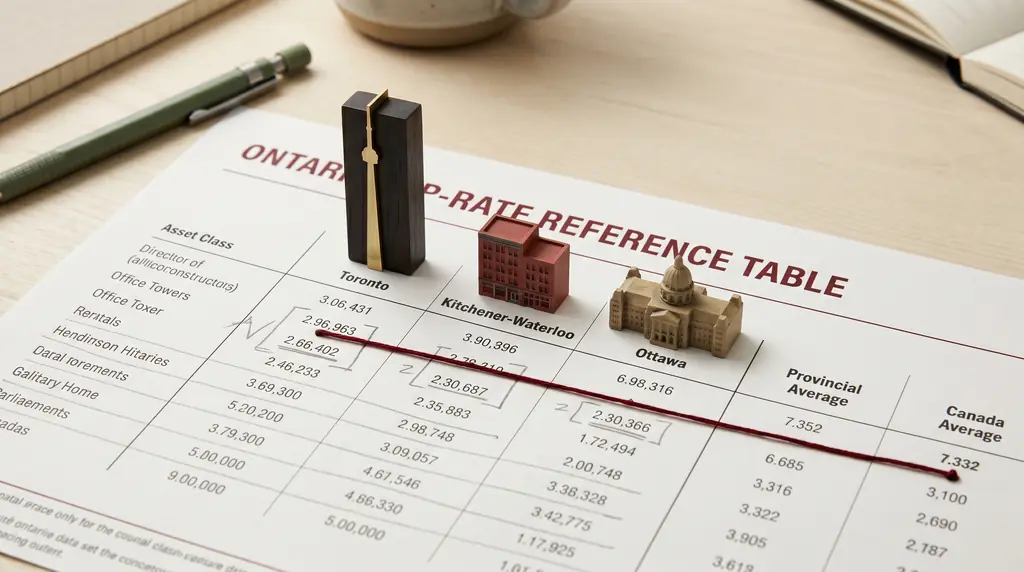
Within Ontario in Q4 2025 (CBRE): Toronto Downtown Class AA office 5.25-7.75%; Toronto Industrial Class A 5.00-5.25%; Kitchener-Waterloo Downtown Class A office 6.00-6.75%; KW Industrial Class A 5.75-6.50%; Ottawa Downtown Class AA office 6.25-6.50%. For the full Ontario picture, see our pillar guide to Ontario commercial cap rates 2026 and our analysis of GTA office cap rate compression.
Frequently asked questions
How is cap rate different from yield?
Cap rate is one specific kind of yield: the unlevered, year-one yield on stabilized NOI at the purchase price. Other yield measures - cash-on-cash return, internal rate of return (IRR), levered yield - incorporate debt, multi-year cash flows, or reversion. IRR is the richer measure for hold-period analysis.
Is a higher cap rate better?
It depends which side of the trade you are on. A higher cap rate means a lower price for the same NOI - good for the buyer, less good for the seller. Higher cap rates also reflect higher risk: weaker tenancy, secondary location, shorter lease term, or older improvements. The cap rate is pricing the risk.
What's a good cap rate for commercial property?
There is no single good cap rate. The relevant benchmark is the asset's specific range in the most recent CBRE or Altus quarterly, against the asset's own NOI quality, lease term, and risk profile. A Toronto Industrial Class A at 5.25% is defensible at the wide end of its Q4 2025 range; a Kitchener-Waterloo Class B office at 7.50% is priced for the risk. The comparison is asset-class- and submarket-specific.
Further reading
- Ontario commercial cap rates 2026 - the pillar guide to 2026 Ontario CRE cap rates by asset class and geography.
- How cap rates affect commercial valuation - the arithmetic of the income approach and DCF reversion.
- The income approach in commercial appraisal - the CUSPAP-compliant framework cap rates sit inside.
- DCF vs direct capitalization - when each method applies and how the terminal cap rate drives reversion value.
- GTA office cap rate compression 2026 - the Q4 2025 25 bps Class AA move and the flight-to-quality narrative.
Need a CUSPAP-compliant commercial appraisal? If you need a current-market commercial valuation grounded in 2026 Ontario cap-rate data and signed by an AACI-designated practitioner, request an appraisal. We serve Ontario from our Kitchener-Waterloo practice, founded in 1973.
Update log: 2026-05-15 - Initial publication. Cap rate figures verified against CBRE Q1 2026 (April 21, 2026), CBRE Q4 2025 Canadian Cap Rate Report PDF, and Altus Group Q4 2025 Canadian CRE Investment Trends Survey (January 20, 2026). Will be updated when CBRE Q2 2026 is published.