Ontario industrial cap rates in Q4 2025 ran from 5.00-5.25% (Toronto Class A) to 6.00-7.00% (Kitchener-Waterloo Class B), against a Canadian national industrial average of 5.91% (Class A) and 6.42% (Class B) per CBRE (CBRE Q4 2025 Canadian Cap Rate Report). The load-bearing 2026 trend: Southwestern Ontario industrial availability fell 40 bps year-over-year to 7.2% in Q1 2026 per Altus - the only major regional segment Altus's update reports as improving year-over-year, while national availability rose 40 bps to 6.2% (Altus Q1 2026 Canadian industrial market update, May 1, 2026). Ontario industrial in 2026 is not one market; it is tight Toronto, an improving Southwestern Ontario, and a KW block carrying outsized national supply.
Key Takeaways
- Toronto Industrial Class A at 5.00-5.25% in Q4 2025 is among the tightest industrial prints of any major Canadian market CBRE tracks, second only to Vancouver at 4.50-5.25%; Class B at 5.25-6.00% (CBRE Q4 2025).
- Kitchener-Waterloo Industrial Class A at 5.75-6.50% and Class B at 6.00-7.00% in Q4 2025 sit roughly 75-125 bps wider than Toronto, about 100 bps at midpoint - the structural KW discount to GTA industrial (CBRE Q4 2025).
- Southwestern Ontario industrial availability decreased 40 bps year-over-year to 7.2% in Q1 2026 per Altus - the only major regional segment its update reports as improving year-over-year.
- Canadian national industrial availability rose to 6.2% in Q1 2026 (+40 bps YoY) per Altus, while JLL reported national vacancy at 5.1% - the first decline since 2022 (Altus measures availability including sublet; JLL measures vacancy).
National Q4 2025 industrial cap rates plateaued in the high-5% / low-6% range, with Ontario markets spanning the full envelope.
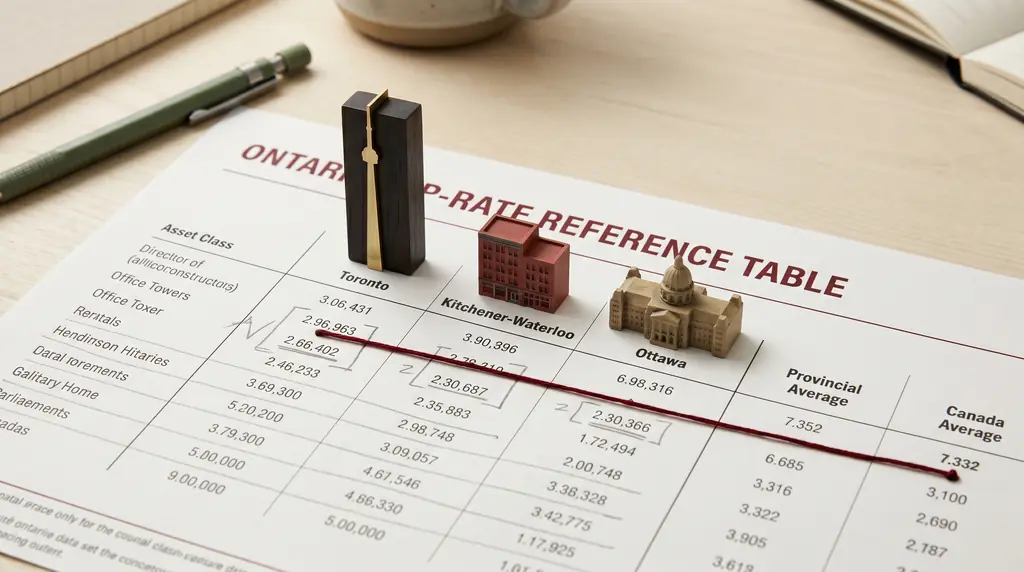
CBRE's Q4 2025 cap rate report places Canadian Industrial Class A at 5.91% and Class B at 6.42%, a combined average of 6.16% (–3 bps QoQ). Altus's single-tenant industrial benchmark was 6.00% in Q4 2025 per the Altus Q4 2025 Canadian CRE Investment Trends Survey (January 20, 2026). The series have plateaued after the 2022-2024 expansion; the 2026 question is which sub-markets reprice and in which direction. The table below sets the three Ontario markets CBRE tracks by name against the national average.
| Geography | Industrial Class A (Q4 2025) | Industrial Class B (Q4 2025) | Q1 2026 availability |
|---|---|---|---|
| Canada national avg | 5.91% | 6.42% | 6.2% (Altus); 5.1% vacancy (JLL) |
| Toronto | 5.00 - 5.25% | 5.25 - 6.00% | 5.1% |
| Kitchener-Waterloo | 5.75 - 6.50% | 6.00 - 7.00% | 6.8% (4.2% vacancy) per CBRE Waterloo Region Industrial Figures Q1 2026 |
| Ottawa | 5.50 - 6.00% per CBRE Q4 2025 | 6.25 - 6.75% per CBRE Q4 2025 | 4.1% - the lowest in Canada (Altus) |
| Southwestern Ontario (regional) | (rolls up into KW + London) | (rolls up into KW + London) | 7.2% (–40 bps YoY) |
Sources: CBRE Q4 2025; Altus Q1 2026; JLL Q1 2026; CBRE Q1 2026 industrial figures.
The geographic breakdown: Toronto tightest, KW the national-supply outlier, Southwestern Ontario improving.
Greater Toronto Area
Toronto Industrial Class A at 5.00-5.25% in Q4 2025 is among the tightest industrial cap-rate prints in the CBRE national series, second only to Vancouver Class A at 4.50-5.25%. Q1 2026 industrial availability of 5.1% per Altus, with three consecutive quarters of positive net absorption, reflects continued logistics demand against a substantial pipeline - the GTA carries 9.8M sf under construction, the largest active industrial pipeline in Canada.
Kitchener-Waterloo and Southwestern Ontario
KW Industrial Class A at 5.75-6.50% and Class B at 6.00-7.00% sits roughly 75-125 bps wider than the equivalent Toronto bands, about 100 bps at midpoint. The structural discount reflects deal size, tenant covenant depth, and market liquidity - not weaker fundamentals. The Waterloo Region drove a disproportionate share of national industrial activity in Q1 2026: CBRE Canada Industrial Figures Q1 2026 (April 2026) reports Waterloo Region carried 20.0% of national new industrial supply - second only to Toronto - with rents up 2.9% quarter-over-quarter, and the region posted roughly 1.15M sf of positive net absorption, about a quarter of the national total (CBRE Waterloo Region Industrial Figures Q1 2026). Across the broader Southwestern Ontario block, Q1 2026 completions were 3 buildings totalling approximately 424,000 sf at roughly 75% available - thin completion volume against continued absorption is the proximate explanation for the 40 bps year-over-year availability improvement. See our Kitchener-Waterloo commercial market report for the broader market context.
Ottawa
Ottawa Industrial Class A was 5.50%–6.00% and Class B was 6.25%–6.75% in Q4 2025 per CBRE Q4 2025. Ottawa industrial sits at the wider end of the national envelope but significantly tighter than Ottawa's office market. Ottawa office availability rose 170 bps year-over-year to 14.2% in Q1 2026 per Altus, driven by federal disposal-plan dynamics; the industrial picture is more insulated from that office-side pressure. Ottawa Q1 2026 industrial availability was 4.1% per the Altus Q1 2026 industrial update - the lowest of any major Canadian market Altus tracks; Ottawa does not roll into the Southwestern Ontario block in the Altus series.
What is driving 2026 industrial movement: logistics demand, selective capital, and a Bank of Canada hold at 2.25%.
Three forces shape Ontario industrial in 2026. First, structural logistics demand: JLL's national vacancy reading of 5.1% in Q1 2026 - the first decline since 2022 - signals demand re-engaging supply after the 2023-2024 expansion. CBRE's Q2 2026 national figures extend the turn: availability eased 10 bps quarter-over-quarter to 5.5%, its first decline since Q3 2022. Second, selective capital: Altus Q4 2025 reported total Canadian CRE investment volume of approximately $51 billion in 2025, an 8% year-over-year decrease, with the bid-ask gap as the central friction; industrial transactions skew toward Class A modern logistics where lenders and institutional buyers can underwrite confidently. Third, the macro rate anchor: the Bank of Canada held the overnight rate at 2.25% on July 15, 2026 (Bank of Canada policy decision) - the sixth consecutive hold - supporting stable spreads (317 bps national cap-rate-to-10-year-GoC in Q1 2026 per CBRE) and a stable cost-of-debt assumption for industrial refinancing. For the broader refinance view, see our Canadian CRE refinance cycle 2026 analysis.
What this means for industrial commercial appraisals in Ontario.
Three implications for a CUSPAP 2026-compliant industrial appraisal. First, the Toronto-versus-KW basis spread is structural and must be defended explicitly when transactions in one market are used to support a value in the other - a 75 bps cap rate gap on the same NOI moves indicated value by roughly 12% on a 6.00% reference rate. Second, the Southwestern Ontario availability improvement is the standout regional fundamentals tailwind in the Altus national picture; for going-in cap rate selection on a KW or southwestern-Ontario asset, the rate-of-change in availability supports the lower half of the CBRE Q4 2025 range absent asset-specific reasons to widen. Third, CBRE's quarterly Waterloo Region industrial figures, alongside the gated JLL Southwest Ontario insight, are the most important secondary data sources for KW industrial work. To commission an industrial appraisal grounded in the Q1 2026 data above and signed by an AACI-designated practitioner, request an appraisal.
Frequently asked questions
What is the typical industrial cap rate in Toronto in 2026?
Toronto Industrial Class A was 5.00-5.25% and Class B was 5.25-6.00% in Q4 2025 per CBRE - among the tightest industrial bands of any major Canadian market CBRE tracks, second only to Vancouver. Q1 2026 industrial availability of 5.1% per Altus supports that pricing.
How do Kitchener-Waterloo industrial cap rates compare to Toronto?
KW Industrial Class A at 5.75-6.50% sits roughly 75-125 bps wider than Toronto Class A at 5.00-5.25% (CBRE Q4 2025) - a structural discount reflecting deal size, tenant covenant depth, and market liquidity.
Why is Southwestern Ontario industrial improving when the rest of Canada is not?
Southwestern Ontario was the only major regional segment reported as improving year-over-year in the Altus Q1 2026 update, with availability of 7.2% (–40 bps YoY). The driver is disciplined supply (Q1 2026: 3 completions totalling ~424,000 sf) against continued absorption, particularly in the Waterloo Region.
Further reading
- Ontario commercial cap rates 2026 - the pillar guide to all asset classes and Ontario markets.
- GTA office cap rate compression 2026 - the Q4 2025 25 bps Class AA move and the flight-to-quality narrative.
- Kitchener-Waterloo commercial market report - the KW envelope across asset classes and submarkets.
- Canadian CRE refinance cycle 2026 - the 2021 five-year wall, the bid-ask gap, and lender underwriting context.
- what is a cap rate - the canonical NOI / value definition, formula, and going-in versus terminal distinction.
- About our Kitchener-Waterloo practice - founded 1973, AACI-designated, Ontario-wide commercial appraisal services.
Update log: 2026-05-14 - Initial publication. Cap rate ranges verified against CBRE Q4 2025 Canadian Cap Rate Report PDF. Q1 2026 availability figures verified against Altus Q1 2026 Canadian industrial market update (May 1, 2026) and JLL Canada Industrial Q1 2026 (April 21, 2026). Bank of Canada rate verified against the April 29, 2026 policy decision. Ottawa industrial-specific ranges, KW-specific Q1 2026 industrial availability, and the JLL Waterloo Region absorption figure flagged for follow-up extraction against the gated JLL Southwest Ontario Industrial Insight PDF. 2026-07-15 - Fact-check pass: KW Q1 2026 availability filled at 6.8% (CBRE Waterloo Region Industrial Figures, April 28, 2026); Ottawa Q1 2026 availability filled at 4.1% (Altus, May 1, 2026); Waterloo Region supply share and rent growth reattributed to CBRE Canada Industrial Figures Q1 2026; Toronto tightest-market claim corrected (Vancouver Class A 4.50-5.25% is tighter); Bank of Canada hold count updated to sixth consecutive (July 15, 2026); CBRE Q2 2026 national availability context added; dead CBRE PDF links replaced with the live CBRE cap rate report page.