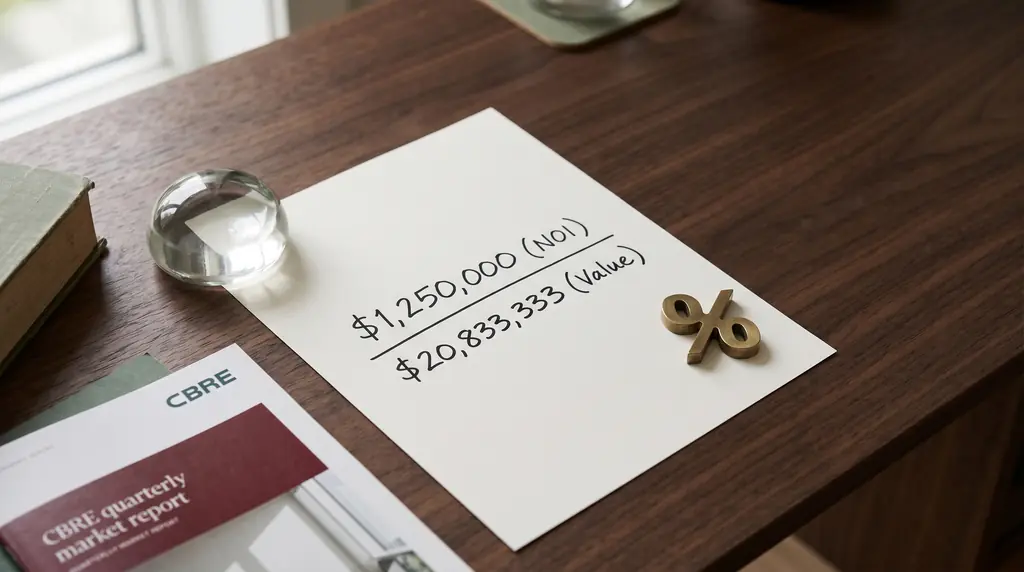
Cap rates affect commercial property valuation inversely through a single relationship: Value = NOI / Cap rate. With NOI held constant, a 25 bps cap rate movement shifts a stabilized commercial value by roughly 4 percent at a 6 percent starting cap, and a 50 bps move shifts value by roughly 7 to 8 percent. That sensitivity is why a quarterly report from CBRE Canada or Altus Group moves prices within weeks of publication, and why lenders re-underwrite loans against current cap rates rather than acquisition-era ones. The questions below settle what an owner, lender, or counsel needs to know before reading a 2026 Ontario commercial valuation.
Key Takeaways
- Cap rate and value move inversely under the income approach - Value = NOI / Cap rate. NOI held constant.
- A 25 bps cap rate shift moves stabilized commercial value by 4 to 6 percent depending on the starting cap. A 50 bps move on a $200,000 NOI changes value from $3.33M at 6.00 percent to $3.08M at 6.50 percent - a roughly 7.5 percent drop.
- Cap rates change for three reasons: cost of debt, the spread investors demand over the 10-year Government of Canada bond, and asset-specific risk. CBRE reports a Q1 2026 spread of 317 bps over the 10-year GoC bond.
- When cap rates rise, values fall, LTV ratios compress against the new appraised value, and refinancing borrowers must top up equity or accept smaller loans - the central dynamic of the Canadian CRE refinance cycle in 2026.
How cap rates affect commercial valuation - the core questions
What's the relationship between cap rate and property value?
The cap rate is the denominator of the income approach: Value = NOI / Cap rate, where NOI is stabilized net operating income (a one-year forward figure net of vacancy, operating expenses, and management fees, before debt service and income tax). A property generating $1,000,000 of stabilized NOI is worth $16.67M at a 6.00 percent cap rate, $16.00M at 6.25 percent, and $17.39M at 5.75 percent. Cap rate is the most-used summary statistic under the income approach as codified in CUSPAP 2026, mandatory for all AIC assignments completed on or after April 1, 2026. For the canonical definition, see what is a cap rate.
How much does a 25 bps cap rate change shift my property value?
At a 6.00 percent starting cap, 25 bps shifts value by approximately 4 percent. At 5.00 percent, the same 25 bps shifts value by roughly 5 percent. At a 4.50 percent multifamily cap, 25 bps moves value by about 5.5 percent. The sensitivity is nonlinear: the lower the starting cap rate, the larger the percentage value change from a fixed bps movement.
Why do cap rates change?
Three forces. First, the cost of debt - the 10-year Government of Canada bond yield and the Bank of Canada overnight rate set the risk-free benchmark and the floor on senior debt pricing. The Bank of Canada has held the overnight rate at 2.25 percent since October 2025, with a sixth consecutive hold on July 15, 2026 (Bank of Canada decision). Second, the spread investors demand over the bond - CBRE reports a Q1 2026 spread of 317 bps, tighter quarter-over-quarter. Third, asset-specific risk - lease term, tenant credit, asset class, and submarket fundamentals.
Does the appraiser pick the cap rate?
The appraiser selects a cap rate by triangulating from market evidence - completed transactions, published quarterly reports (CBRE, Altus, Colliers, Avison Young, JLL), and active investor feedback - then defends the selection against the subject's NOI quality, lease term, and risk profile. Under CUSPAP 2026, the cap rate is a defended professional opinion, not a free pick.
How does the BoC policy rate affect commercial cap rates?
The Bank of Canada policy rate does not move cap rates directly - it moves the 10-year GoC bond yield, which moves the spread investors require, which moves cap rates. The transmission is not one-for-one. Through 2025 the Bank cut a cumulative 100 bps; cap rates did not fall 100 bps. The CBRE Q1 2026 national average of 6.61 percent reflects spread tightening more than headline rate movement. Colliers Q1 2026 flagged the alternative path - rate increases later in 2026 if inflation reasserts - as a live risk.
What happens to my LTV when cap rates rise?
When cap rates rise, appraised value falls. LTV is computed against current appraised value, not historical cost. A property purchased in 2021 at a 4.50 percent cap with 65 percent LTV debt may, on a 2026 refinance, appraise at 6.00 percent - roughly a 25 percent value decline on flat NOI. The original loan now sits near 87 percent of current value. The borrower brings fresh equity, accepts a smaller loan, or negotiates an extension - the central dynamic of the Canadian CRE refinance cycle.
Is there a "right" cap rate for my property?
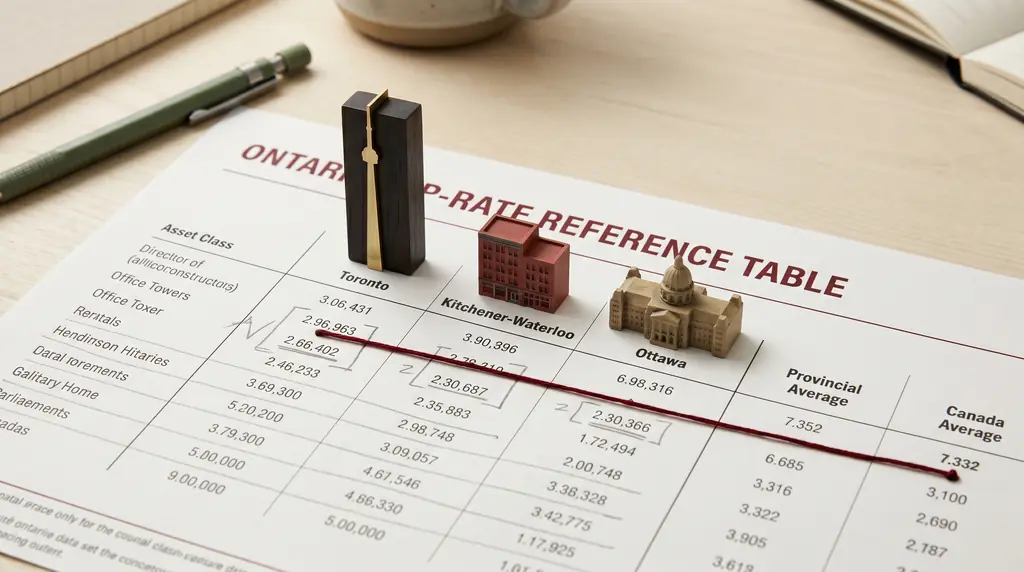
There is a defensible range, not a single right number. The range is set by the published quarterly figures for the asset's class and submarket - in 2026 Ontario, the CBRE Q1 2026 report for Toronto, Kitchener-Waterloo, and Ottawa, plus the Altus quarterly Investment Trends Survey. Within the range, the subject's NOI quality, lease term, tenant credit, condition, and submarket fundamentals determine where it sits.
Sensitivity worked example - the math behind a 50 bps cap rate move
Consider a stabilized commercial property generating $200,000 of net operating income (a small retail strip, a 12-unit multifamily building, or a single-tenant industrial bay). The cap rate moves 50 basis points - from 6.00 percent to 6.50 percent over a 12-month refinance horizon:
- Value at 6.00 percent: $200,000 / 0.06 = $3,333,333
- Value at 6.50 percent: $200,000 / 0.065 = $3,076,923
- Value change: -$256,410, or approximately -7.5 percent
Same NOI. Same building. The percentage change is scale-invariant. For the DCF case, the terminal cap rate (the assumed exit-year cap rate used to derive reversion value) produces an even larger present-value swing because the reversion often represents 50 to 70 percent of total present value on a 10-year hold - a 50 bps terminal shift can move implied current value by 6 to 10 percent on its own. CUSPAP 2026 requires defending going-in and terminal rates independently. For the DCF treatment, see income approach.
Refinance implications - rising cap rates compress LTV and force borrower top-ups
Properties acquired in 2021 at sub-4 percent cap rates with five-year debt are facing 2026 appraisals at cap rates often 150 to 250 bps wider:
- $20M acquisition in 2021 at a 4.00 percent cap rate ($800,000 NOI), 65 percent LTV ($13M loan, $7M equity).
- 2026 refinance appraisal at 6.00 percent cap values the asset at $13.33M.
- The $13M loan now sits at 97.5 percent of current appraised value.
- A 65 percent LTV refinance supports only $8.67M - the borrower brings $4.33M in fresh equity, negotiates an extension, accepts mezzanine, or sells.
Altus Q4 2025 attributes the 8 percent year-over-year decline in 2025 Canadian CRE investment volume (~$51 billion total) directly to this bid-ask gap - sellers anchored to 2021 pricing, buyers underwriting at 2026 cap rates. For the full picture, see the Canadian CRE refinance cycle post.
Further reading
- Ontario commercial cap rates 2026 - the pillar guide with Q1 2026 numbers across Toronto, KW, and Ottawa.
- what is a cap rate - canonical definition, formula, going-in versus terminal.
- income approach - direct capitalization versus DCF under CUSPAP 2026.
- GTA office cap rate compression 2026 - the Q4 2025 25 bps Class AA move.
- Canadian CRE refinance cycle - the 2021 five-year wall and lender underwriting context.
Commission a defensible cap rate analysis. If you need a CUSPAP 2026-compliant commercial appraisal that defends both going-in and terminal cap rate selections against current Ontario market evidence, request an appraisal. We serve Ontario from our Kitchener-Waterloo practice, founded in 1973.
Update log: 2026-05-15 - Initial publication. Figures grounded in CBRE Q1 2026 Canadian Cap Rates and Investment Insights (April 21, 2026), CBRE Q4 2025 Cap Rate Report PDF, Altus Q4 2025 ITS (January 20, 2026), and Bank of Canada April 29, 2026 rate decision. Will be updated when CBRE Q2 2026 and Altus Q1 2026 ITS are published.