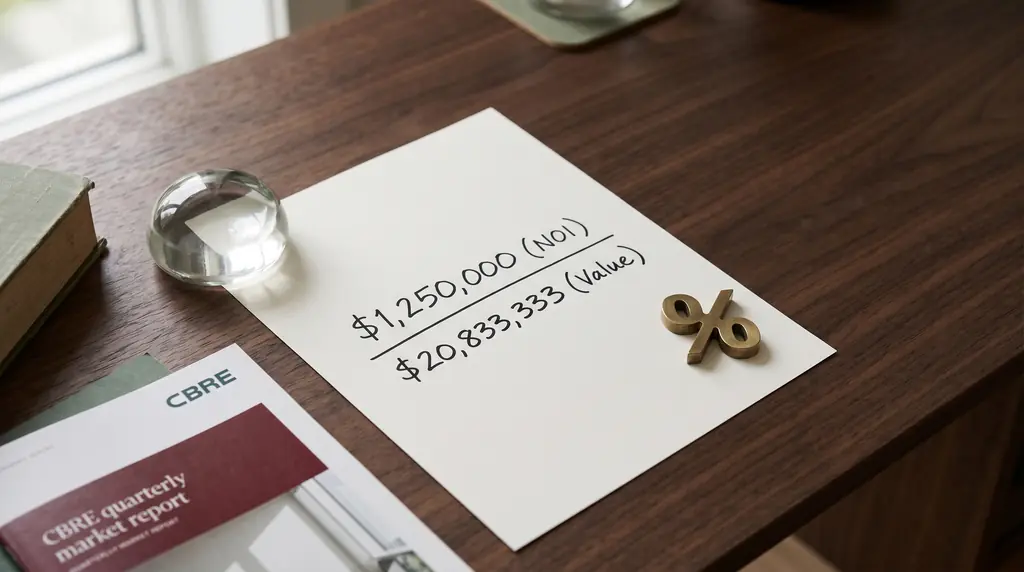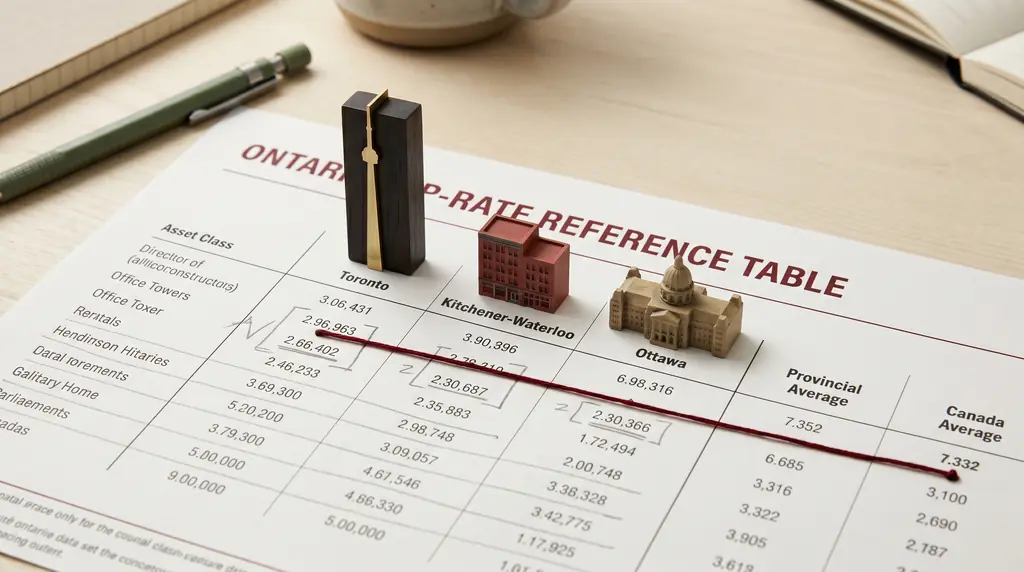
The Guelph commercial real estate market in 2026 has no separately published cap rate series. Guelph is not one of the 13 markets CBRE tracks by name in its Q1 2026 Canadian Cap Rates and Investment Insights, and Altus Group rolls Guelph into its Southwestern Ontario block. What an AACI-designated practitioner does instead is triangulate: the CBRE Q1 2026 Kitchener-Waterloo envelope as the adjacent geographic proxy, the Altus Q1 2026 Southwestern Ontario industrial print (7.2% availability, -40 bps year-over-year), London as a CBRE-tracked secondary-market parallel, and first-party direct-comparison evidence from Guelph transactions.
Key Takeaways
- Guelph has no published commercial cap rate series. Any cited "Guelph cap rate" is either a KW proxy, a Southwestern Ontario rollup, or an unsourced estimate.
- The defensible anchors for a Guelph valuation in 2026 are the CBRE Q1 2026 Kitchener-Waterloo envelope, the Altus Q1 2026 Southwestern Ontario rollup, London as a CBRE secondary-market parallel, and first-party Guelph comps.
- Southwestern Ontario industrial availability fell 40 bps year-over-year to 7.2% in Q1 2026 per Altus - the only region in Altus's Q1 2026 industrial update to post a year-over-year decrease.
- CUSPAP 2026 requires the named AACI signatory to ground every cap rate selection in attributable evidence. When data is silent, the burden shifts from citation to direct-comparison work and to disclosure of what is not knowable.
Why Guelph commercial market data is hard to find
CBRE Canada's Q1 2026 report tracks 13 markets by name - London and Kitchener-Waterloo among them, but not Guelph. The Q4 2025 PDF is the same. Altus rolls regional figures into broader buckets such as Southwestern Ontario. Colliers, Cushman and Wakefield, Avison Young, and JLL do not publish regular Guelph-isolated series. Guelph EDC publishes attraction content, not yield data. CMHC's KW-CMA does not include Guelph - it is its own CMA. MPAC commercial assessments for 2026 remain anchored to the postponed January 1, 2016 valuation date. A citation to a "Guelph cap rate" without methodology is, in CUSPAP 2026 terms, undefended.
The three adjacent-market reads that anchor a Guelph valuation
With no Guelph series available, an AACI practitioner triangulates from three published anchors plus first-party comp work.
1. The CBRE Q1 2026 Kitchener-Waterloo envelope - the adjacent geographic proxy. Guelph sits roughly 25 kilometres east of KW on the same Highway 401 corridor with overlapping labour markets. CBRE's KW figures are the most-recent published city-level cap rates within commuting distance: Downtown Office A 6.00-6.75%, B 6.50-7.25%; Industrial A 5.75-6.50%, B 5.75-6.50%; Multifamily High Rise A 4.50-4.75%; Retail Strip (anchored) 5.50-6.35%. The Kitchener-Waterloo commercial market report sets out the full envelope.
2. The Altus Q1 2026 Southwestern Ontario industrial rollup - the regional trend read. Altus reports Southwestern Ontario industrial availability at 7.2% in Q1 2026, down 40 bps year-over-year - the only region in Altus's Q1 2026 industrial update to post a year-over-year decrease (national availability rose to 6.2%). Q1 2026 regional completions delivered three buildings totalling approximately 424,000 square feet at roughly 75% available at delivery. Guelph industrial sits inside this rollup. For the cross-Ontario context see Ontario industrial cap rate trends.
3. London as the CBRE-tracked secondary-market parallel. London is the other CBRE-tracked Southwestern Ontario market and the closest published analogue to Guelph in tier. From the CBRE Q1 2026 Canadian Cap Rates and Investment Insights (ranges unchanged from Q4 2025): London Downtown Office A 7.00%–8.00%, B 7.75%–8.75%; Suburban Office A 5.75%–6.75%, B 6.00%–7.25%; Industrial A 5.50%–6.25%, B 6.00%–7.00%. London is a calibration reference, not a substitute citation.
Guelph's economic backdrop - University, agri-food, and 401-corridor distribution
The University of Guelph is one of the city's largest employers and the anchor of an agri-food and veterinary research cluster. University-adjacent rental demand and faculty-staff household formation drive a multifamily picture structurally tighter on the demand side than KW's tech-driven equivalent. KW Multifamily High Rise A at 4.50-4.75% in Q1 2026 is the adjacent envelope; position inside it is comp-driven.
Agri-food and life-sciences employers (Linamar is also Guelph-based) drive demand for specialised industrial and flex space different in character from KW's logistics-heavy pipeline.
401-corridor distribution adjacency. Guelph's Hanlon Expressway and Highway 401 access place it inside the GTA distribution shed. Toronto Industrial A at 5.00-5.25% in Q1 2026 is among the tightest industrial prints in major Canadian markets (only Vancouver, at 4.50-5.25%, is lower); KW Industrial A at 5.75-6.50% sits 75-125 bps wider. Guelph industrial with GTA-distribution utility tends to track the tight end of the KW range.
How an AACI sources Guelph-specific comps when published data is silent
Layer 1 - the envelope. Start from the CBRE Q1 2026 KW envelope as the published adjacent-market anchor; cross-check against the Altus Southwestern Ontario industrial print for trend direction; note CBRE London as the secondary-market calibration reference. None of these is a Guelph number; together they bound the range a Guelph cap rate selection can defend.
Layer 2 - direct-comparison evidence. CUSPAP 2026, mandatory for all AIC assignments completed on or after April 1, 2026, requires the appraiser to ground value conclusions in verifiable evidence. For Guelph that means direct-comparison work on Guelph transactions - MPAC and Geowarehouse records, brokerage listing histories, client rent rolls, and the practice's own transaction file built over multiple cycles.
Layer 3 - explicit disclosure. The CUSPAP report names the data sources, the adjacent-market anchors relied on, and the boundary of what is and is not knowable from public series.
What this means for a Guelph commercial valuation engagement
For lenders, lawyers, asset managers, and owners commissioning a Guelph appraisal in 2026, expect explicit disclosure of the data scarcity, expect comp work rather than citation, and expect a named AACI signatory. The envelope bounds the answer; the comps select it. The AIC reports roughly 5,000+ members responsible for approximately 900,000 appraisals representing more than $1.5 trillion in 2025. In a market with thin published data, the designation is the citation. The Canadian CRE refinance cycle 2026 context makes this load-bearing - lender underwriting against a 2.25% Bank of Canada overnight rate (held July 15, 2026, a sixth consecutive hold) is reading every appraisal more carefully than it has since the 2021 origination wave.
Frequently asked questions
Are Guelph cap rates published anywhere?
No, not as a standalone series. Guelph is not one of the 13 markets CBRE tracks by name; Altus rolls Guelph into its Southwestern Ontario block; Colliers, Cushman and Wakefield, Avison Young, and JLL similarly do not isolate Guelph. The closest published anchors are the CBRE Kitchener-Waterloo envelope (adjacent geographic proxy), the Altus Southwestern Ontario rollup (regional trend), and CBRE London (secondary-market parallel).
Is the Guelph industrial cap rate similar to Cambridge?
Within the same envelope, yes - both share GTA-distribution-shed positioning along the 401 and roll up into adjacent Southwestern Ontario figures (Cambridge into CBRE's KW bucket; Guelph into Altus's Southwestern Ontario block). KW Industrial Class A at 5.75-6.50% and B at 5.75-6.50% per CBRE Q1 2026 is the most-relevant published envelope for both. Submarket-specific differences are direct-comparison-driven. The Cambridge commercial real estate market analysis covers the Cambridge side.
How does an AACI value a Guelph property if there are no comps?
There are always comps - the question is how visible they are. The AACI signatory builds the set from MPAC and Geowarehouse records, brokerage listing histories, client rent rolls, and the practice's own transaction file across cycles. Where direct Guelph comps are thin for a specialised asset class, the report ranges out to the adjacent KW market and discloses the geographic adjustment. The income approach uses the published adjacent-market envelope as the bounding range; direct comparison selects the value inside it. CUSPAP 2026 requires explicit disclosure of sources, methodology, and limits - that disclosure is the defensible product.
Further reading
- Ontario commercial cap rates 2026 - the cross-Ontario pillar synthesis.
- Kitchener-Waterloo commercial market report - the adjacent-market anchor for any Guelph valuation.
- Cambridge commercial real estate market - the Cambridge-segment-of-KW analysis.
- Ontario industrial cap rate trends - the cross-Ontario industrial picture Guelph rolls into.
- About Appraisals.on.ca - the AACI-designated, Kitchener-Waterloo-founded practice serving Guelph since 1973.
Commission a Guelph commercial appraisal. For a CUSPAP 2026-compliant appraisal signed by an AACI-designated practitioner from a firm that has read the KW and Guelph commercial markets since 1973, request a Guelph commercial appraisal.
Update log: 2026-05-15 - Initial publication. Anchors: CBRE Q4 2025 Canadian Cap Rate Report PDF (Kitchener-Waterloo envelope as adjacent geographic proxy); Altus Group Q1 2026 Canadian Industrial Market Update (Southwestern Ontario availability 7.2%, -40 bps year-over-year, May 1, 2026); CBRE Q1 2026 Canadian Cap Rates and Investment Insights (April 21, 2026); AIC CUSPAP 2026 (effective April 1, 2026). 2026-05-21 - London CBRE Q4 2025 cap rate figures (Downtown A/B, Suburban A/B, Industrial A/B) added from CBRE Q4 2025 Canadian Cap Rate Report PDF. 2026-07-15 - KW envelope re-baselined to CBRE Q1 2026 Canadian Cap Rates and Investment Insights (April 21, 2026): Multifamily High Rise A 4.50-4.75%, Industrial Class B 5.75-6.50%; London figures re-cited to Q1 2026 (ranges unchanged); Toronto industrial superlative qualified (Vancouver Industrial A at 4.50-5.25% prints lower); dead CBRE Q4 2025 PDF links replaced with the CBRE Q1 2026 report page; Bank of Canada rate sourced to the July 15, 2026 hold.